GDPR fines represent the most tangible consequence of non-compliance, and they've grown substantially since enforcement began in 2018. For compliance and privacy managers, understanding the fine structure isn't just academic; it's a practical necessity that shapes budgets, risk assessments, and audit priorities. The regulation's two-tier penalty system can impose fines up to €20 million or 4% of global annual turnover, whichever is higher.
That range alone should make any organization pay attention. A thorough GDPR compliance checklist must account for the specific violations that trigger penalties and the factors supervisory authorities weigh when calculating them. Data privacy risk assessment isn't optional anymore. This guide breaks down the penalty framework into actionable steps so you can evaluate your exposure, strengthen your compliance posture, and avoid becoming a cautionary headline. For a broader look at how AI tools are transforming privacy compliance management, that context is worth exploring alongside these enforcement specifics.
Key Takeaways
- GDPR fines fall into two tiers with maximum penalties of €10 million or €20 million.
- Supervisory authorities consider ten specific factors when calculating fine amounts.
- Proactive compliance audits and documentation significantly reduce penalty risk.
- The largest GDPR fines have targeted big tech companies for consent and transparency failures.
- Small and mid-sized organizations face enforcement too, not just multinational corporations.
1. Understand the Two-Tier Fine Structure
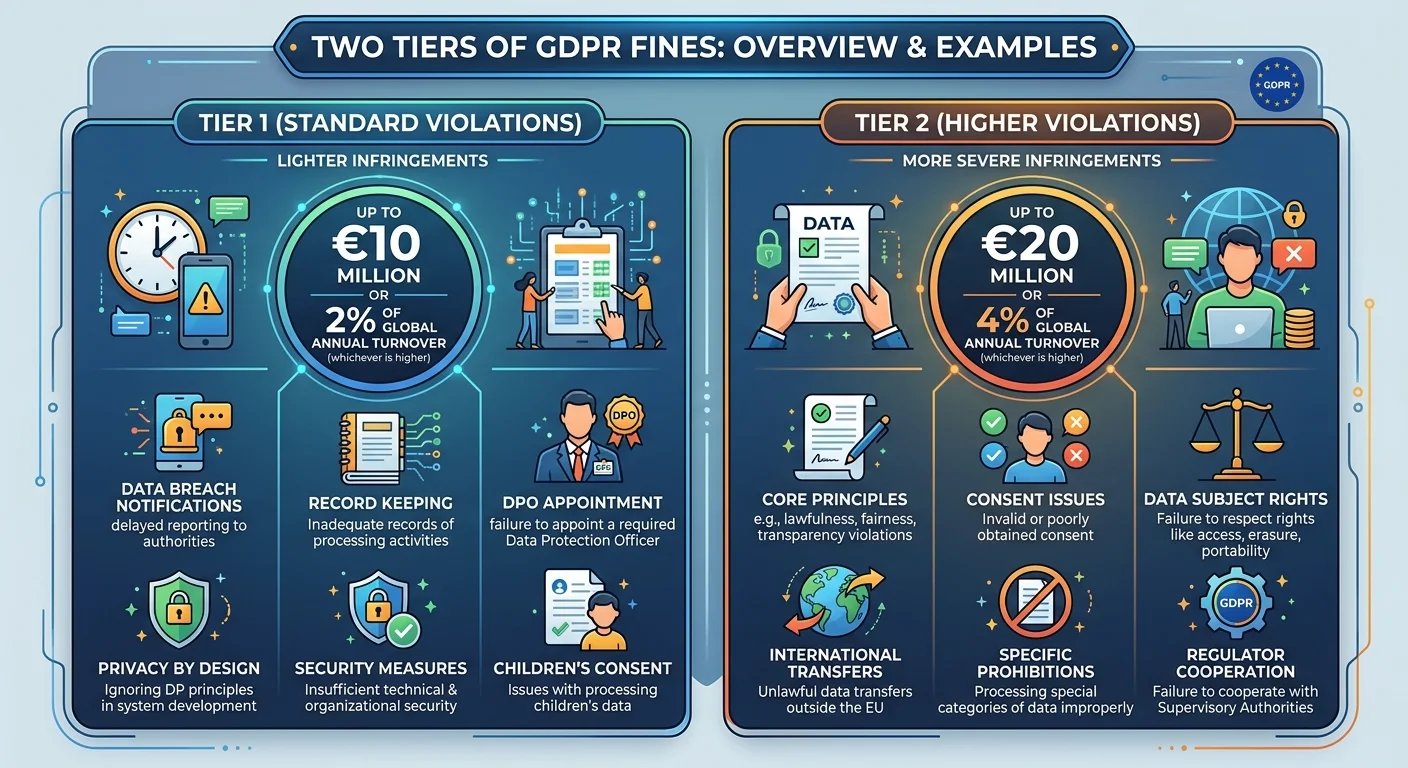
The GDPR doesn't impose a single blanket penalty. Instead, Articles 83(4) and 83(5) establish two distinct tiers of administrative fines based on the severity and nature of the violation. This tiered approach gives supervisory authorities flexibility while maintaining proportionality. Understanding which tier your potential violations fall into is the first step in any meaningful risk assessment.
Tier One Violations
Tier one covers infringements related to obligations of controllers and processors, certification bodies, and monitoring bodies. Maximum fines reach €10 million or 2% of the worldwide annual turnover from the preceding financial year, whichever amount is greater. These violations are considered less severe but still carry enormous financial weight. Examples include failures to implement proper data protection by design, inadequate record-keeping of processing activities, or not conducting required data protection impact assessments.
Tier Two Violations
Tier two addresses the most fundamental GDPR principles. Violations of the basic principles for processing, conditions for consent, data subject rights, and international data transfer rules all fall here. The maximum fine doubles to €20 million or 4% of global annual turnover. For a company like Amazon (fined €746 million by Luxembourg's CNPD in 2021), the percentage-based calculation produces staggering numbers. These violations strike at the core of what the GDPR was designed to protect.
| Aspect | Tier One (Art. 83(4)) | Tier Two (Art. 83(5)) |
|---|---|---|
| Maximum Fixed Fine | €10 million | €20 million |
| Percentage of Turnover | 2% | 4% |
| Scope | Controller/processor obligations | Core principles, consent, rights |
| Example Violation | Missing DPIA | Unlawful data processing |
| Severity Level | Moderate | High |
Many organizations mistakenly assume that only the maximum fines matter. In practice, supervisory authorities issue fines across a wide spectrum. A €50,000 fine can be devastating for a small business, just as a €400 million fine impacts a multinational. The proportionality principle means every organization, regardless of size, needs to take both tiers seriously and map their processing activities to the relevant violation categories.
2. Identify What Triggers GDPR Fines
Knowing the fine tiers is helpful, but understanding what specific actions (or inactions) trigger enforcement is where practical value lies. Supervisory authorities across Europe have developed clear patterns in their enforcement priorities over the past six years. By studying these patterns, compliance managers can focus their audit efforts on the areas most likely to attract regulatory scrutiny and potential penalties.
Common Enforcement Patterns
Consent violations represent the single largest category of high-value GDPR fines. Meta received a €1.2 billion fine from Ireland's DPC in 2023 for transferring EU user data to the United States without adequate safeguards. Google was fined €50 million by France's CNIL in 2019 for lack of transparency and valid consent in advertising personalization. These cases reveal that data processing without a proper legal basis, particularly regarding consent, is the highest-risk area for significant penalties.
Data breach notification failures constitute another major trigger. Article 33 requires controllers to notify the relevant supervisory authority within 72 hours of becoming aware of a personal data breach. Late notifications, incomplete reports, or failure to notify at all regularly result in fines. British Airways received a £20 million fine (reduced from an initial £183 million proposal) partly for inadequate security measures that led to a breach affecting approximately 400,000 customers. The reduction itself illustrates that cooperation and remediation matter.
Failing to report a data breach within 72 hours is one of the most common and easily avoidable GDPR violations.
Insufficient technical and organizational security measures round out the top three triggers. This includes outdated encryption, poor access controls, lack of regular security testing, and failure to implement privacy by design. The connection between your technology infrastructure choices and GDPR compliance is real. Even decisions about database systems and their security features can factor into how well your organization protects personal data. Supervisory authorities look at whether organizations took reasonable steps, not whether they achieved perfection.
3. Learn How Fine Amounts Are Calculated
Supervisory authorities don't pull fine amounts from thin air. Article 83(2) of the GDPR specifies ten criteria that must be considered when deciding whether to impose a fine and how much it should be. Compliance managers who understand these criteria can build stronger internal cases for investing in privacy programs, because they can articulate exactly which factors reduce financial exposure.
The Ten Assessment Criteria
The nature, gravity, and duration of the infringement come first. A brief accidental exposure of non-sensitive data will attract far less attention than a prolonged, systematic collection of sensitive personal data without legal basis. Supervisory authorities also assess the intentional or negligent character of the violation. Deliberate non-compliance results in substantially higher fines than accidental infractions. The number of data subjects affected and the level of damage they suffered weigh heavily in the calculation as well.
"Organizations that can demonstrate proactive compliance efforts before a violation occurs consistently receive lower fines than those caught without any privacy program in place."
Actions taken by the controller to mitigate damage represent a powerful mitigating factor. If your organization discovers a breach and immediately contains it, notifies affected individuals, and implements corrective measures, the fine will likely reflect that responsiveness. Prior violations also matter. Repeat offenders face escalating penalties. The degree of cooperation with the supervisory authority can shift the outcome dramatically, as the British Airways case demonstrated when the fine was reduced by roughly 89% from the initial notice.
Document every compliance action your organization takes, including meeting notes, training records, and policy updates. This evidence directly influences fine calculations.
Categories of personal data involved, how the authority learned about the violation (self-reported versus complaint), existing certifications or approved codes of conduct, and any other aggravating or mitigating factors complete the assessment framework. Organizations that adhere to approved codes of conduct or hold relevant certifications may receive more favorable treatment. The key takeaway is that fine calculation is not binary; it's a nuanced evaluation where your preparation and response directly influence the outcome.
Financial capacity of the organization also plays an informal role. While not explicitly listed as a criterion, supervisory authorities have acknowledged that fines should be effective, proportionate, and dissuasive. A €500,000 fine might be proportionate for a mid-sized company but meaningless for a tech giant. This explains why percentage-of-turnover calculations exist, to make penalties sting regardless of organizational size.
Some EU member states have additional national rules that supplement GDPR fine calculations, so check your local data protection authority's guidance.
4. Build a GDPR Compliance Audit to Reduce Risk
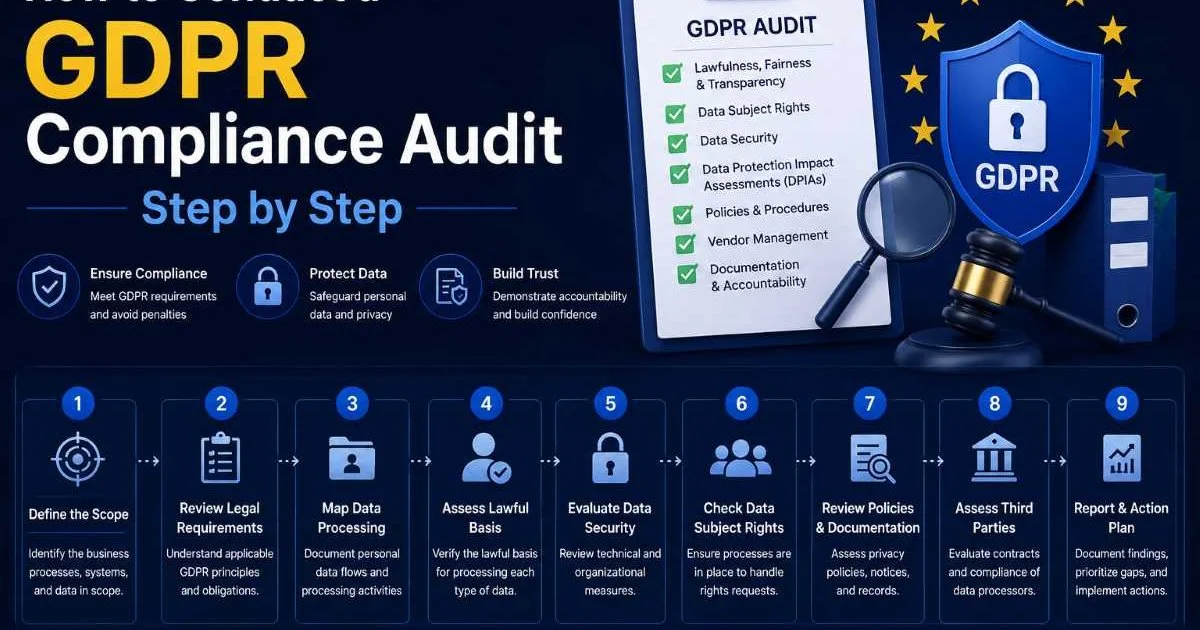
Understanding fines is only useful if it drives action. A structured GDPR compliance audit gives you a systematic way to identify gaps, prioritize fixes, and build the documentation trail that supervisory authorities look for when assessing penalties. This isn't a one-time exercise. Privacy risk assessment should be embedded in your operational rhythm, conducted at least annually and triggered by significant changes in data processing activities.
Practical Audit Steps
Start by mapping all personal data processing activities across your organization. Identify every system, vendor, and process that touches personal data. Cross-reference each activity against your legal basis for processing, whether that's consent, legitimate interest, contractual necessity, or another Article 6 ground. This mapping exercise frequently reveals processing activities that lack a valid legal basis, which is exactly the kind of gap that triggers tier two fines.
Next, review your data subject rights fulfillment processes. Can you respond to access requests within the 30-day deadline? Do you have a functioning mechanism for erasure requests? Test these processes with internal simulations. Many organizations discover that their theoretical compliance breaks down in practice because the right teams aren't connected or the technical infrastructure doesn't support timely responses. Fixing these operational gaps is far cheaper than paying a fine for failing to honor data subject rights.
Run a mock data subject access request quarterly to test your response time and completeness before a real request exposes weaknesses.
Audit your data breach response plan with the same rigor. Walk through a tabletop exercise simulating a breach scenario. Time how long it takes to detect, assess, and report. If your team can't meet the 72-hour notification window during a drill, they won't meet it during a real incident. Document the results of these exercises and the improvements you make afterward. This documentation becomes powerful evidence of proactive compliance if you ever face regulatory scrutiny or a GDPR audit from a supervisory authority.
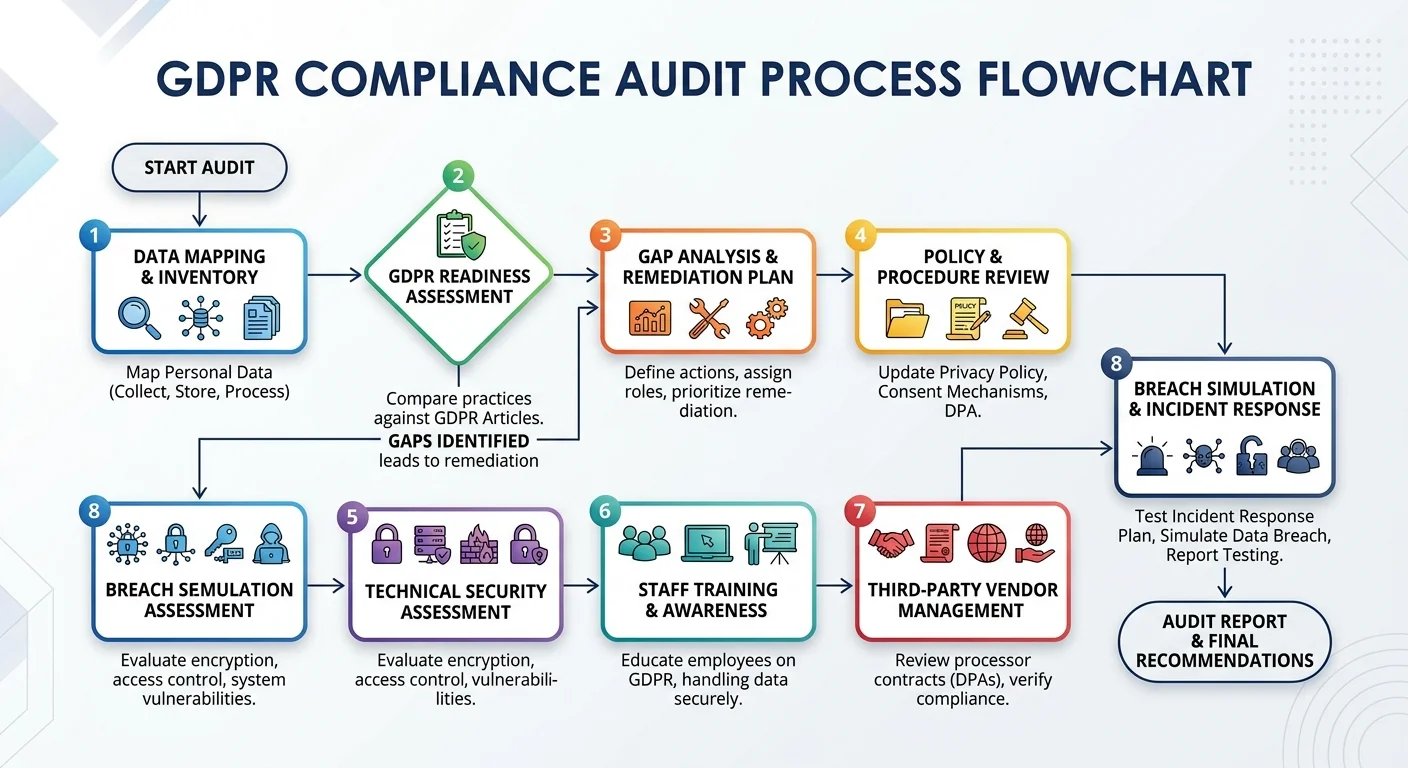
Finally, review your vendor and processor agreements. Article 28 requires specific contractual clauses with every data processor. Verify that each contract includes the mandatory provisions: subject matter and duration of processing, nature and purpose, types of personal data, and obligations of the processor. International data transfers deserve special attention given the enforcement trend highlighted by Meta's record fine. Confirm that appropriate transfer mechanisms, whether Standard Contractual Clauses or adequacy decisions, are in place and documented for every cross-border data flow.
Frequently Asked Questions
?How do I know if my violation falls under Tier One or Tier Two?
?Does the 4% turnover calculation use global or local revenue?
?How long does building a GDPR compliance audit actually take?
?Is it a misconception that only big tech companies get fined under GDPR?
Final Thoughts
GDPR fines are not abstract threats reserved for tech giants. They apply to every organization that processes personal data of EU residents. The compliance and audit steps outlined here give you a practical framework for reducing your exposure. Treat your GDPR checklist as a living document that evolves with regulatory guidance and enforcement trends.
The organizations that avoid the largest fines aren't the ones with the biggest budgets; they're the ones that take privacy risk assessment seriously, document their efforts, and respond quickly when things go wrong.
Disclaimer: Portions of this content may have been generated using AI tools to enhance clarity and brevity. While reviewed by a human, independent verification is encouraged.