Privacy risk assessment for AI systems has become a pressing concern for every compliance and privacy manager operating under the GDPR framework. As organizations deploy machine learning models, chatbots, and automated decision-making tools, the volume and sensitivity of personal data flowing through these systems has multiplied.
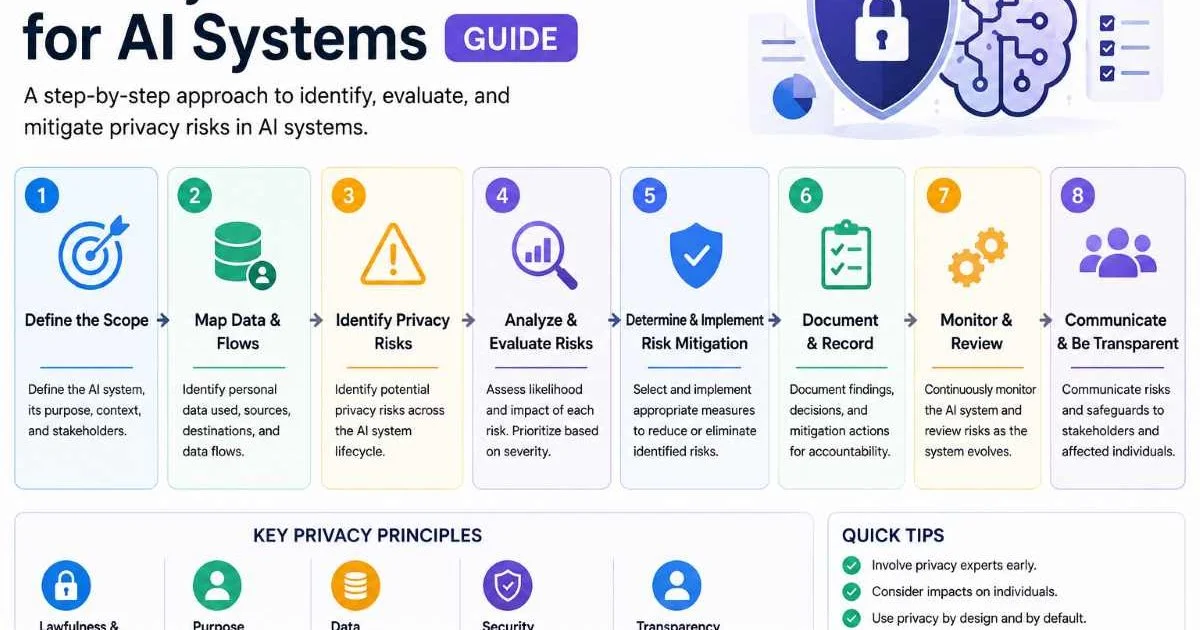
A single overlooked vulnerability in an AI pipeline can trigger a data breach, attract regulatory scrutiny, and result in significant GDPR fines. This guide walks you through a structured, repeatable process for assessing privacy risks in AI systems. Whether you're auditing an existing deployment or evaluating a new vendor's product, these steps will help you identify gaps, document your findings, and build a compliance posture that holds up under examination.
The stakes are real: regulators across Europe are increasingly targeting AI-specific processing activities, and your organization needs a clear methodology to stay ahead.
Key Takeaways
- Map every data flow in your AI system before starting any risk assessment.
- Use a structured checklist to identify GDPR gaps specific to automated processing.
- Document your legal basis for each AI data processing activity separately.
- Conduct Data Protection Impact Assessments whenever AI processes data at scale.
- Review and update your privacy risk assessment at least quarterly.
Step 1: Map Your AI Data Flows and Processing Activities
Identify Data Sources and Categories
Before you can assess risk, you need a complete picture of what data your AI system touches. Start by cataloging every data source feeding into the system: customer databases, web forms, third-party APIs, IoT sensors, and any training datasets used during model development. For each source, classify the data by category (identifiers, behavioral data, biometric data, special category data). This inventory forms the foundation of your entire assessment, and getting it wrong here will cascade into blind spots later. If you're working with a broader AI privacy compliance program, this mapping exercise should align with your existing Records of Processing Activities under Article 30.
Pay special attention to indirect data collection. Many AI systems infer new data points from existing information, creating derived personal data that falls under GDPR scope. A recommendation engine, for example, might generate interest profiles from browsing behavior. These inferences are personal data if they relate to an identifiable individual. Your data map should capture both explicit inputs and generated outputs, including any intermediate processing stages where data is transformed, enriched, or aggregated.
Create a visual data flow diagram for each AI system; spreadsheets alone won't capture the complexity of multi-stage processing pipelines.
Document Processing Purposes
For each data flow, record the specific purpose of processing and the legal basis you're relying on. Article 6 of the GDPR requires a lawful basis for every processing activity, and AI systems often involve multiple purposes (model training, inference, analytics, personalization). Mixing purposes without proper documentation is a common compliance gap. A GDPR checklist for data privacy teams can help you systematically verify that each purpose is properly recorded and justified.
Legitimate interest assessments deserve extra scrutiny in AI contexts. If you're relying on Article 6(1)(f), you need a documented balancing test that weighs your organization's interest against the data subject's rights. Automated profiling or large-scale behavioral analysis rarely passes this test without robust safeguards. When consent is your basis, verify that it meets GDPR standards: freely given, specific, informed, and unambiguous. Consent collected for one purpose cannot be silently extended to cover AI model training.
Step 2: Assess Privacy Risks and GDPR Compliance Gaps
Build a Risk Scoring Framework
With your data map complete, you need a consistent method for scoring risks. Build a matrix that evaluates each processing activity across two dimensions: likelihood of a privacy incident and severity of impact on data subjects. Score each dimension on a scale of one to five. A risk score of likelihood multiplied by impact gives you a prioritized list. Activities scoring above 15 (out of 25) should be flagged for immediate remediation. This structured approach replaces gut-feel assessments with something auditors and regulators can actually review.
Your framework should account for AI-specific risk factors that traditional assessments often miss. Consider model explainability: can you explain to a data subject why the AI made a particular decision about them? Opacity in AI decision-making raises the risk profile significantly, especially when decisions affect access to services, credit, or employment. Factor in data retention practices too. Training datasets often persist far longer than necessary, and stale personal data sitting in model pipelines creates unnecessary exposure.
"The biggest privacy risks in AI systems aren't in the algorithms themselves but in the data pipelines that feed them."
Common AI Risk Patterns
Certain risk patterns appear repeatedly across AI deployments. Bias and discrimination represent both an ethical and legal risk under GDPR, since Article 22 gives data subjects the right not to be subject to solely automated decisions with legal effects. Data minimization violations are another frequent finding; AI teams tend to collect more data than strictly necessary, hoping it will improve model performance. Each extra field of personal data collected without justification is a compliance gap waiting to be exploited.
Third-party risk is equally important. If your AI system relies on external APIs, pre-trained models, or cloud-based ML platforms, each vendor relationship introduces new data flows and processing activities. Your assessment must extend beyond your own infrastructure. Verify that processors have adequate safeguards, appropriate data processing agreements, and that cross-border transfers comply with GDPR Chapter V requirements. Understanding the potential financial consequences outlined in GDPR fines and penalties guidance reinforces why cutting corners on vendor due diligence is never worth it.
Never assume a third-party AI vendor is GDPR compliant simply because they claim to be; always verify with your own due diligence and contractual safeguards.
Step 3: Conduct a DPIA and Compliance Audit for AI Systems
When Is a DPIA Required?
Article 35 of the GDPR mandates a Data Protection Impact Assessment whenever processing is likely to result in a high risk to individuals' rights and freedoms. AI systems trigger this requirement frequently because they often involve systematic evaluation of personal aspects (profiling), large-scale processing of special categories of data, or innovative technological applications. If your risk scoring from Step 2 flagged any activity above the threshold, a DPIA is almost certainly required. The European Data Protection Board's guidelines list automated decision-making with legal or similarly significant effects as a clear trigger.
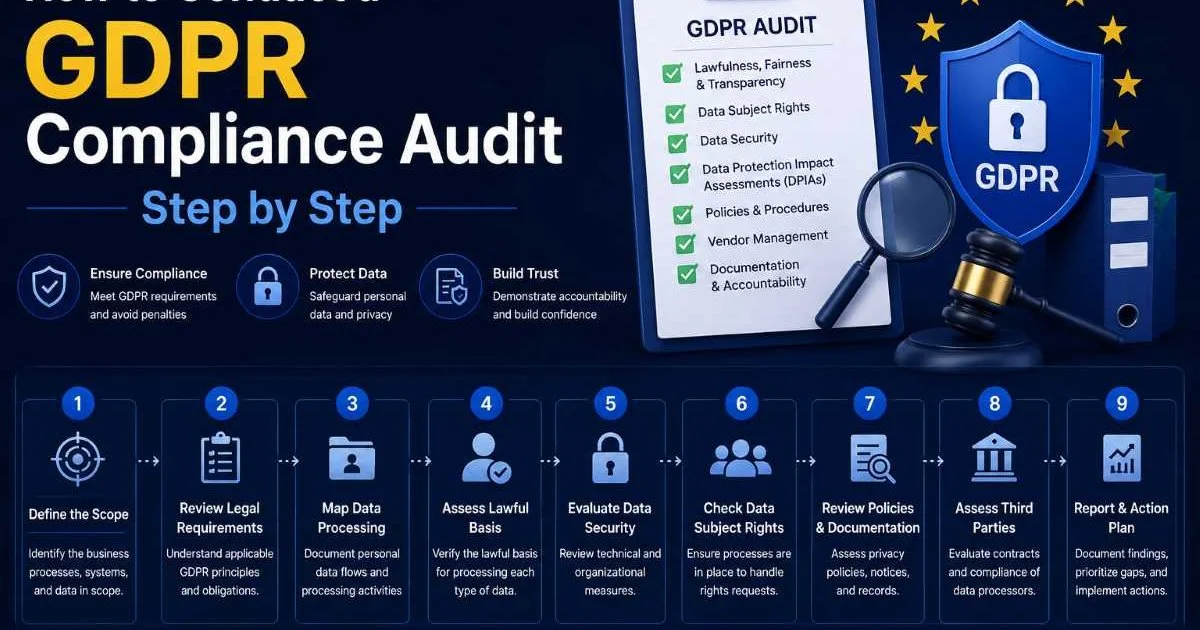
A DPIA isn't a one-time checkbox exercise. It should be a living document, updated whenever the AI system changes materially. This includes changes to training data, model architecture, the scope of data subjects affected, or the introduction of new output categories. For a detailed walkthrough of the audit process, refer to our guide on how to conduct a GDPR compliance audit step by step, which covers documentation standards and evidence-gathering techniques applicable to AI systems.
Audit Execution Checklist
Your DPIA and audit should cover a structured set of checkpoints. The table below outlines the core areas to evaluate during an AI-focused compliance audit. Each item maps directly to specific GDPR articles and should produce documented evidence of compliance or a remediation action item. Assign clear ownership for each area; vague responsibility assignments are a leading cause of audit failures.
| Audit Area | GDPR Article | Key Question | Evidence Required |
|---|---|---|---|
| Legal Basis | Art. 6 | Is each processing purpose documented with a lawful basis? | Processing register, LIA records |
| Transparency | Art. 13/14 | Are data subjects informed about AI-driven processing? | Privacy notices, consent forms |
| Automated Decisions | Art. 22 | Can individuals opt out of solely automated decisions? | Process documentation, opt-out mechanism |
| Data Minimization | Art. 5(1)(c) | Is only necessary data collected and processed? | Data inventory, justification records |
| Data Transfers | Art. 44-49 | Are cross-border transfers covered by appropriate safeguards? | SCCs, adequacy decisions, TIAs |
| Security | Art. 32 | Are technical measures proportionate to risk? | Security assessment, encryption policies |
Some supervisory authorities publish sector-specific DPIA templates; check your local data protection authority's website before building one from scratch.
During the audit, interview the engineering team directly. Compliance documentation often describes an idealized version of data processing that doesn't match reality. Ask engineers about data access controls, how training data is sourced and refreshed, and whether any personal data persists in model weights or logs. These conversations frequently uncover risks that paper-based reviews miss entirely.
Step 4: Implement Controls and Ongoing Monitoring
Technical Safeguards
Translating your assessment findings into concrete controls is where many organizations stumble. Start with the highest-risk items from your scoring matrix. Implement data anonymization or pseudonymization at the earliest possible point in the AI pipeline. Apply access controls based on the principle of least privilege, so that only team members who genuinely need personal data for their role can access it. Encryption at rest and in transit should be a baseline, not a stretch goal. Using AI-powered tools for monitoring data flows can help you detect anomalies in real time and flag potential breaches before they escalate.
Model-level controls matter too. If your AI system makes automated decisions affecting individuals, build in human review mechanisms for high-stakes outputs. Implement logging that captures the inputs, model version, and outputs for each decision so you can respond to data subject access requests and provide meaningful explanations. Retention policies should apply to inference logs just as they apply to raw datasets; storing decision records indefinitely creates unnecessary risk and storage costs.
Set automated alerts for data volume anomalies in your AI pipeline; a sudden spike in data ingestion often signals a misconfigured data source or unauthorized access.
Organizational Measures
Technical controls alone won't sustain compliance. Establish a governance framework that assigns clear accountability for AI privacy risks. Designate a point of contact within the data protection team for each AI system, and require that team to review and sign off on any material changes to the system's data processing. Regular training for engineering and product teams on GDPR obligations specific to AI is not optional; it's a regulatory expectation. Document everything: meeting notes, risk decisions, remediation timelines, and sign-offs.
Schedule formal reassessments at least quarterly, or whenever a significant change occurs. Significant changes include new data sources, deployment to new markets, changes in the volume of data subjects, or updates to the AI model itself. Between formal reviews, maintain a risk register that tracks open items, assigned owners, and target completion dates. Monitoring tools should feed into this register automatically where possible, creating a feedback loop between operational reality and your compliance documentation. Privacy risk assessment for AI is not a project with a finish line; it's an ongoing discipline that evolves with your technology and the regulatory landscape.
Frequently Asked Questions
?How often should I update my AI privacy risk assessment?
?Does a DPIA replace the Article 30 Records of Processing Activities?
?How long does a full AI compliance audit typically take?
?Is derived or inferred data from AI models treated as personal data under GDPR?
Final Thoughts
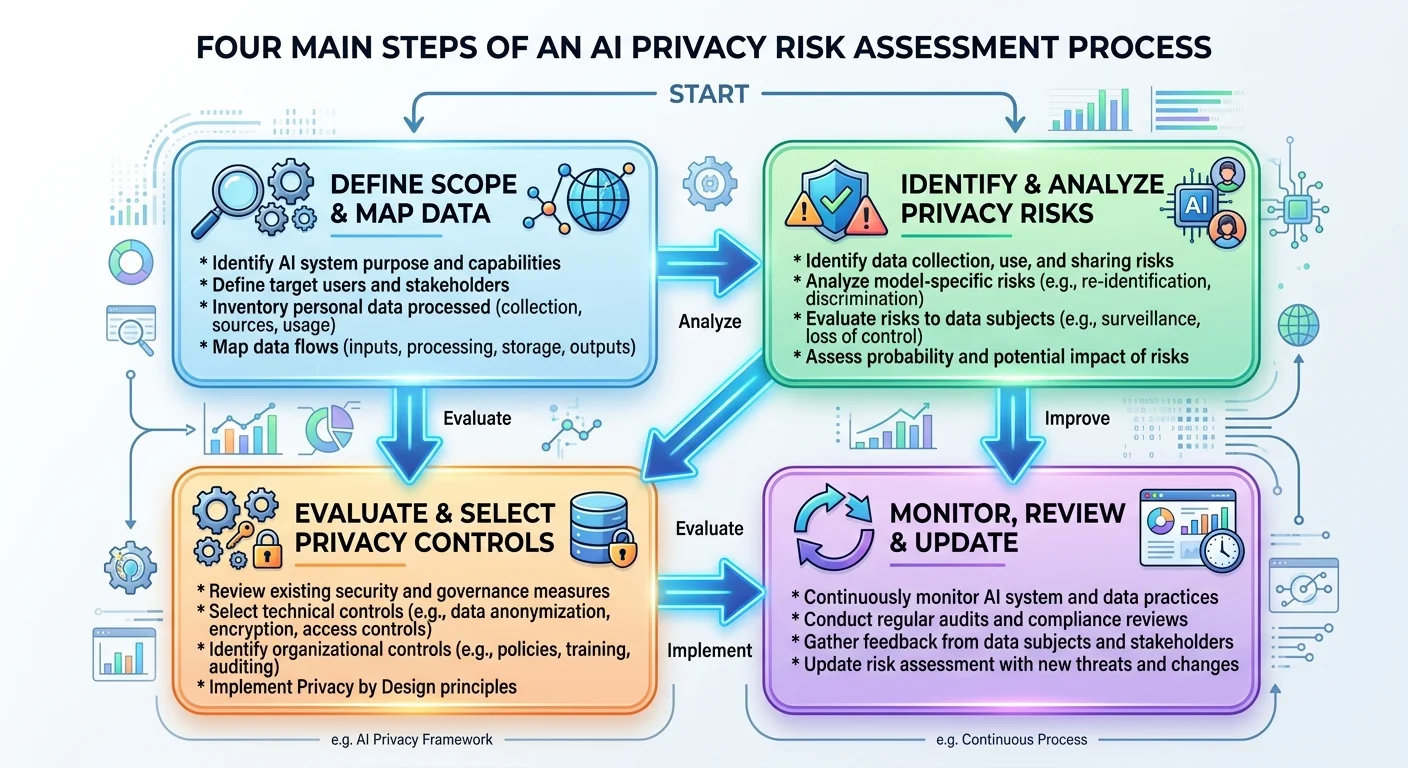
Privacy risk assessment for AI systems is a discipline that demands both technical depth and regulatory knowledge. The four steps outlined here, mapping data flows, scoring risks, conducting DPIAs and audits, and implementing controls, give you a repeatable framework that scales with your AI portfolio.
Regulators are paying closer attention to automated processing every year, and the organizations that invest in structured assessments now will face far fewer surprises during inspections. Start with your highest-risk system, work through this process methodically, and build the institutional muscle to make privacy risk assessment a routine part of your AI development lifecycle.
Disclaimer: Portions of this content may have been generated using AI tools to enhance clarity and brevity. While reviewed by a human, independent verification is encouraged.